
Resume tips: How to write a great CV
- Thecvxpert
- Mar 7, 2023
- 6 min read
Resumes come in all shapes, sizes, styles and lengths. And let’s face it – many of them are terrible. So what are the basic tips for resume writing? What makes a good resume and what should you avoid?

Here’s what we’ll cover in this comprehensive blog:
Structural tips for including all the right resume sections
Writing tips for making your words leap off the page
Formatting tips to increase readability and attractiveness
Common mistakes and how to avoid them
Our top tips for structuring your resume
1. First, study the job posting.
You need to figure out what to say before you figure out how to say it. And that starts with knowing what the employer wants, because you’ll never catch any fish if you’re using bait they don’t like.
Employers know what they’re looking for, and they usually spell this out explicitly when posting a job listing. What you need to do as a job applicant is to make the language of your resume match the help-wanted ad as closely as possible.
One reason this is so important is because of Applicant Tracking Systems (ATS) , which rank resumes according to whether or not they contain the keywords an employer is looking for. The place to find these keywords is in the job posting. This is also why you should tailor your resume for each employer, changing it up each time you apply for a job in order to highlight the qualifications that each employer is seeking.
2. Structure your resume properly.
How many pages should a resume be? A resume should usually be one page only, though two pages is sometimes considered OK if you have a lot of experience in your field.
So what are the five main things your CV should include? It should be structured as follows, with these five components:
Header
Summary/profile
Employment history
Education
Skills
These elements don’t necessarily have to be in this order. If you have little or no experience because you’re still in college or just got your degree, education can come before employment history. In rare cases, employment history can be left out entirely if you have none, though it’s best to include one with at least internship or volunteer experience.
In many resume designs, the skills list appears in a margin under the contact info, fairly high on the page. In others, it appears at the bottom, and in still others, it appears somewhere in the middle.
Most experts say you should leave references off your resume, or if the employer requests them, they can be included in a separate document. Do not include the phrase “References available upon request.”
3. Create an eye-pleasing header.
The header is the space at the top of the resume that contains the following contact info:
Name: This comes at the very top, and should usually appear in the largest font size on the page. (Do not include the word “Resume” at the top, as it should be pretty obvious this is a resume.)
Occupation: List your occupation under your name (“Painter,” “Plumber, “SEO Marketing Specialist,” etc.).
Address: Some say your snail-mail a is unnecessary in today’s digital world, especially if applying for a remote job. But we recommend you include it unless there’s a good reason not to. At the very least, include your city and state/province (if applying for a job in your own country), or city and country if applying for a job in a foreign market.
Email address: Use a professional email address that contains part or all of your name, hosted by a recognized email provider. Do not apply for a job using an email like partygirl@cheapemails.com – unless, of course, your job is planning parties.
Phone number: Don’t forget the area code, and the country code if applying for a job outside the country.
Optional photo: Some resume designs include a head shot of the job candidate, but be careful with this, as resume photos are mostly frowned on in the U.S., though they are more common in Europe.
Optional web link: You can include your LinkedIn page, your Twitter handle or a link to your blog if these sites reflect your professional accomplishments more than your private life.
Your header needs to be attractively designed and laid out, with smart use of typography, white space and perhaps an accent color. The same is true of the rest of your resume, and we’ll talk more in a bit about how to pull this off.
Here is an example of a header aligned along the left side of a resume:
Our top 5 resume writing tips
1. Write a summary that will keep people reading.
The summary , also known as a profile, personal statement or job objective, is probably the most challenging part of the resume to write. These few lines of text under the header should serve as both a professional self-portrait and an “elevator pitch,” making a compelling case that you are the right candidate for the job.
Economy of words is key. You do not need to say what your name is, as this already appears in large type in the header, and you do not even need to use the word “I” – or to use complete sentences. If you start off with “Senior UNIX engineer with 12 years of experience,” the hiring manager will know you’re talking about yourself.
The summary should describe your occupation, your qualifications and perhaps the type of job you’re looking for, if that’s not immediately obvious. If your entire summary talks about being a child-care provider, you don’t need to say you’re looking for a job as a child-care provider. But if your summary describes several past occupations, it may be necessary to clarify what kind of job you’re seeking.
Use strong adjectives and action verbs, both in describing your personal traits and in relating what you did at past jobs. If your educational credentials or certifications are a selling point, mention them too. You can also list some of your most marketable skills.
But won’t the rest of the resume be dedicated to your work history, education and skills? Yes, and that’s why this is called a “summary.” Find your strongest selling points and highlight them here, using the most persuasive writing possible.

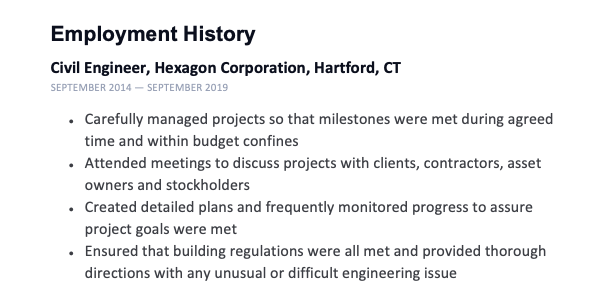
2. Make your employment history about your most impressive accomplishments on the job.
List the relevant jobs you’ve held in your field for the past 10 to 15 years, providing the name and location of the company, your job title and the years you worked there. Then include some bullet points below each one that focus on your most impressive achievements at those jobs.
Avoid saying “Was responsible for” or “Duties included” and focus on what you actually accomplished. Be specific, using facts and figures like revenue growth, customers served, employees you supervised, etc.
If you’ve held lots of jobs, you don’t have to list them all. But if your work experience is thin, look for opportunities to mention internships or volunteer experience.
In most cases, work experience should be listed in reverse chronological order – current or last job first, and first job last. But if you’ve had a nontraditional career path, if you’re a freelancer or contractor or if there are gaps in your work history, you may be better served by the functional format , which groups past work by job category rather than along a timeline.
3. Craft your education section according to its importance in your career path.
List your educational achievements also in reverse chronological order – highest degree first. Include the institutions you attended, the degree you earned and the years you studied.
You can also include bullet points under each of these – for an exceptional grade-point average, membership in honor societies or other distinctions.
But if you have a lot of work experience and many years in the workforce, your education is less important and should be given less space. On the other hand, if you have little work experience because you’re just finishing school, you should consider beefing up this section and perhaps putting it first.
If you have a postsecondary degree, there is no need to mention the high school you attended, though it does no harm if you have room.
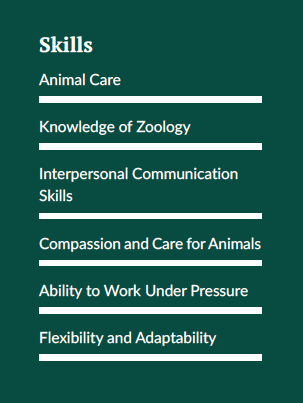
4. Highlight your most impressive talents in your skills list.
Include a list of your most marketable hard and soft skills. Hard skills are job-related technical talents like computer programming, dog grooming or expertise in preparing gourmet dishes in a busy kitchen. Soft skills are non-technical talents like managerial abilities or time management.
Beware of cliches, which are sadly common in skills sections. Many resume writers list “Communication skills,” but these are mentioned so often that these words have become fairly meaningless. Do not say you are a “Team player” who “Thinks outside the box.” Avoid “fluff,” which is language that sounds impressive but says nothing. Reach deep into your vocabulary to find ways of saying things that recruiters haven’t seen a thousand times before.
5. Be cautious about including anything else.
Notice that five resume components are mentioned above, not six. Header, summary, employment, education and skills – that’s all you need, and you should think twice before you decide to include anything else.
What should you avoid in your resume? Some resume advisers will tell you it might be a good idea to include a section for your “ Hobbies and interests ,” but this is usually a bad idea. If you have hobbies that are relevant to the job you’re seeking, then you can consider this. But every section of your resume should be dedicated to describing skills that demonstrate why you are good at your occupation, so steer clear of anything irrelevant.


Comments